DFCv4 D-Jet Connection.
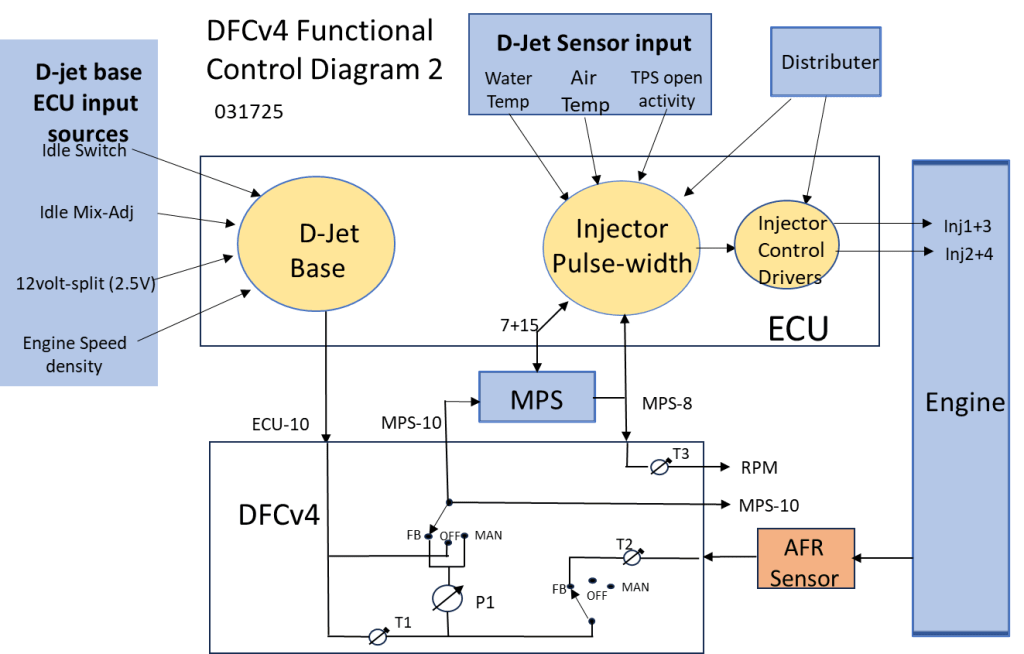
As indicated below the DFCv4 is connecting to the D-jet system using the ECU-to-MPS signals (10, 8).
The front panel slide switch is used to:
A: disable the DFC (middle position).
B: set the DFC to operate in Manual Feedback Mode (right position)
C: set the DFC to operate in Automatic O2-enabled Feedback Mode (left position)
Two trim-pot-meters (T1 and T2) are used to set a base AFR level for Manual and Automatic Feedback Mode. A third trim-pot-meter (T3) is used to calibrate the RPM monitoring signal for use in 4/6 or 8 cylinder D-jet cars.
The front panel potentiometer (P1) is used for further adjustment of the previous (T1, T2) set Manual or Automatic AFR settings while driving.
Benefits for connecting the DFCv4 to your D-jet system:
When operating the DFCv4 in manual mode the car owner is using the T1 trim to adjust the base AFR level to a desired value at a given RPM / MPS load condition. This adjustment will eliminate potential offsets in fuel pressure, injector performance, engine speed-density and overall engine wear conditions which may otherwise cause undesirable driving conditions. Not forgetting cars that may be using ECU, MPS, injectors or TPS models which are not specified for the car-model in use. Without the DFCv4 T1 the resulting AFR level is determined by the D-jet system alone which may no longer be optimal.
When operating the DFCv4 in feedback mode (with O2 sensor connected) the T2 trim setting will not just eliminate the undesirable car and D-jet offset conditions described above for the manual mode operation but also enable setting of a specific AFR level to be maintained when the car is driven at different RPM and engine/MPS load conditions. When using MPS and ECU models not specified for the car in question, or when using nonstandard camshafts, the DFCv4 feedback mode will correct such deviations. The feedback functionality extends well into the idle 800-1200 RPM range which allows the car to be driven without using the ECU idle-mixture controls (simply adjust the TPS to eliminate closing of the idle switch).
The DFCv4 AFR feedback circuit reacts within 100-200 msec to enrich the fuel mixture whenever the AFR level is detected to fall below the set AFR level to be maintained. This allows for the car to be driven with acceptable performance even when the TPS is disconnected, hereby eliminating the TPS enrichment pulses otherwise sent to the ECU when accelerating.
However, with such reactive DFCv4 feedback functionality there is one drawback to consider. As the Full Load operation mode is entered the MPS is signaling the ECU to enrich the fuel mixture. When this is detected the DFCv4 will counteract and gradually return the enriched AFR, approaching the previously preset base AFR feedback level. For car owners that want to drive their car in continuing racing situations there is an expanded DFCv4 module (called the DFCv4 Calibrator) which allows for setting a separate Full Load AFR level that can be configured to trigger when the intake vacuum level dips below a pe-settable point anywhere within the 12 to 4 inch vacuum range.
See Controls page for further description of all the DFCv4 controls and interfaces.

Any comments to this page?
 D-jet Feedback Controls
Comment will show as anonymous if no name is entered – name & email entry is optional.