Introducing a plugin device which provides Air Fuel Ratio (AFR) feedback functionality to the BOSCH D-jet car owners.
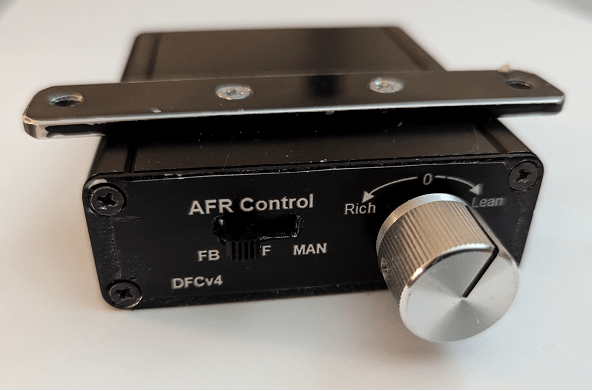
The Ver4 D-Jet Feedback Controller (DFCv4) module located under the car dash, allows for manual or O2-sensor feedback adjustments of the AFR levels, which otherwise is controlled only by the D-Jet MPS and ECU components.
As detailed in the D-jet Connection page, the DFC is connected to the MPS-ECU interface via a customized DFC MPS/ECU Adapter (DMEA), which can easily be removed and therefore quickly restore the original D-Jet engine configuration. No ECU or MPS modifications are required. Ground, 12V and MPS/ECU signals for the DFCv4 are supplied to the DFC via a custom cable routed between the engine compartment and the under-dash DFC location.
The DMEA is connecting to the D-jet system via ECU-to-MPS signals (10, 8), which is very similar for all MPS/ECU modules installed in various car models. It is therefore likely the DFC can be used unchanged in several D-Jet equipped car models – like Volvo, Porsche, Mercedes, VW etc. (years 69 to 74).
Installation and use of an O2 AFR sensor is not required but recommended. For further information regarding the DFCv4 interconnections to the D-jet system and associated benefits when operating in the manual or automated modes – see the D-Jet-Connection page or use the menu-links above for further details.

So far only a few DFCv4 prototype modules have been developed and tested using a D-jet Engine Simulator system and a D-jet equipped Volvo 1800E car, it is therefore currently not available for sale. However, if you are interested in purchasing and testing a DFCv4 device (if/when it becomes available) or if you are interested in joining a non-profit DFCv4 development and test group aiming in making the DFCv4 available for sale – please drop an email to dfcv4support@phoenixkr.com, post your intersects on the D-jet development-list ( including Subject Keyword: DEFv4) — or add your interests into the comments field below for others to see on the WEBsite.
Any comments to all of the above appreciated:
Name: optional, if entered it will show, if not entered it will show as Anonymous.
Email: optional, will not show – except for site admin, if entered the notification options at end of comment can be set to receive subsequent update notifications via email.
If you want others to see your email address to enable them to contact you directly, just include email in comment text.
17 responses to “DFCv4-Introduction”
-
This looks great! I think this page could do with a paragraph on what improvements someone can expect to see by installing this device. And it would help to define terms like “AFR” and maybe “DFC” on first usage.
I’ve owned a Volvo 1800ES in Perth, Australia for nearly 40 years and have always been interested in adding feedback to its open-loop D-jet system, so would like to be involved in the dev & test group if my skills could help.
I’m a career software developer and architect with many years of experience with Python, C, C++ and Java, including embedded/microcontroller programming here and there along the way.
I’m also an electronics hobbyist with fairly basic skills, but knowledge of KiCad and microcontroller applications etc.
LikeLike
-
Hi Steve, I added some text to the D-jet-Connection page describing benefits for adding the DFCv4 to the D-jet system.
LikeLike
-
-
Ebbe, I would be interested in all you proposed on the D-jet Development group site.
LikeLike
-
Thanks for your support! Hope there are more to come from others as the DFCv4 introductions are proceeding.
The goal with the phoenixkr.com website is to allow access and comments from multiples D-jet car use groups – like Volvo, Mercedes, VW, Porsche, etc. The entry on the djetdevelopment site shows a link to the phoenixkr.com site only. The djetdevelopment site cannot support posting of a complete WEB-site.LikeLike
-
-
I am very interested in this modification to the M117 D-Jet system for Mercedes-Benz. The concept is similar to the evolution of K-Jet to KE-Jet. Your DFCv4 coupled with an AFR kit produces something akin to DE-Jet.
My hope is that this device will fine tune the D-Jet system optimizing power and efficiency.
LikeLike
-
Thanks Brad. I have added more text to the D-jet-Connection page describing the benefits for adding a DFCv4 to the D-jet sytem.
LikeLike
-
-
I’m game for purchasing and testing one. Happy to help out with development too but my skills are pretty minimal in that area.
LikeLike
-
I’m keen on adding one to my 1800e. I currently have an IPD. Modified ecu with a coarse mixture adjustment to allow for the 2130cc overbore. Would I use these together or just put a resistor across the IPD contact?
LikeLike
-
Hi Pieter, yes if you disconnect the IPD box and instead connect two resistors (3.9k + 5.1k) in series to the ECU, you will restore the original functionality of your otherwise modified ECU.
EbbeLikeLike
-
Thanks Ebbe,I look forward to this important update to our Djet systems to become availab
LikeLike
-
-
-
Interested. I have 2 1971 142E’s with D-Jetronic.
LikeLike
-
Hola, tengo un VW412 del 73,con D-jetro, funciona perfectamente , variando la presión de combustible ajusto el CO en alta y con trimer de la ECU ajusto al ralentí, me gustaría probar su sistema.
Saludos desde España.Google Translation:
Hello, I have a 1973 VW 412 with a D-jet. It works perfectly. I adjust the CO2 to high by varying the fuel pressure, and I adjust it to idle with the ECU trimmer. I’d like to try your system.
Greetings from Spain.LikeLike
-
Looks interesting! I am at an age when it might be too late for me 😦
I already have a full time AFR with display on dash. It works well. I am the DFC :), but seldom have made adjustments to MPS.
What I wonder is how the DFC will be programmed to adjust mixture for different engine load conditions and for different types of Djet engines. For example, even a 3.5L Mercedes M116 3.5L has different mixture requirements than an M117 4.5L. And of course, different from Volvos and others.
Hopefully smarter minds have figured this out.LikeLike
-
Graham,
The fuel mixture setting for the different 4,6, 8-cylinder car models are only determined by the D-jet components installed in the car as long as a DFCv4 is installed and switched to the OFF position. When the DFCv4 is switched to the MAN position the fuel mixture can be modified further to obtain a more desirable fuel mixture (within AFR range 17 to11) using the T1 DJ-Base trim. Further adjustments can also be made while driving using the front AFR Adj pot meter. See the Controls web-page for details. Similar adjustments can be made when DECv4 is switched to the FB position, after an AFR sensor/display is installed.
Although a future DFCv4 prototype unit will be adjusted before shipment to fit a typical D-jet engine, it is important the D-jet car owner is re-adjusting the DFCv4 module when installing it in a particular car. Initial adjustments should first be in the garage while running engine at 2000-3000 RPM in neutral gear. Further adjustment can also be made while driving on the road. Specific adjustment steps will be made available in the draft DFCv4 User Manual which is yet to be finished.
Only when the driving conditions may be changing significantly could a DFCv4 re-adjustment be necessary This happened when a Volvo 1800E owner using a DFCv2 prototype, the engine ran a bit too lean while driving over 9,000 ft in altitude when using only the front knob to adjust the AFR level. After he adjusted the DFCv2 unit using the side trim he had no AFR issues continuing to drive at the 7,000 ft elevations.
Dave FLikeLike
-
-
I applaud this effort and am very interested in feedback control on my D-Jet Mercedes.
Reading this website, I do not see mention of what sort of signal interface is planned for the AFR. Is this to be a 0-5V signal from a wide-band AFR?LikeLike
-
Allen – Affirmative
LikeLike
-


 D-jet Feedback Controls
Leave a Reply to Eugene Cancel reply